Showing posts with label Pre-Service Training. Show all posts

Tuesday, February 4, 2014

Swearing-In Ceremony

The most exciting day of PST was swearing in! Not only because it meant that I would soon be traveling to my permanent site, but also because I had the honor of giving the swearing-in speech for our Silozi class in front of our Country Director, US Ambassador to Namibia, and the Namibian Deputy Minister of Education.


In English, the body of my speech read:

"Today is the culmination of eight weeks of language, technical, safety and cultural training. As we know, it is a long application process, and most of us have been waiting for this day for twelve months or more. During those months, we could never have imagined the warm welcome that was waiting for us in Namibia. When we arrived at the training site, our trainers sang welcome songs to us, and it has been as though everyone we have met has had a welcome song in their hearts.


The six of us going to Zambezi Region come from all over the US and each of us takes a different piece of the US to their host community. We have come to work with promising business ventures and educational counterparts here in Namibia. We have come to prepare a new generation of Namibians for an increasingly interconnect global community in which Namibians will play an important role. We have also come to learn. Over the next two years, we look forward to getting to know our counterparts, learners, and communities. We can only hope to do justice to the hospitality that has been extended to us in the short time we have already been here.

This process has been facilitated by fantastic language trainers. We have been prepared to serve in Zambezi Region by the enthusiastic, kind-hearted and patient Mama Rosa, whose teaching style and sense of humor has been an excellent preparation for, and introduction to, the Zambezi culture and people. We could not be more excited as we prepare for two years serving the people of the Zambezi Region and are excited about the future as we prepare to go to our sites.

Thank you all and god bless."

Peace Corps Language Training

Language assignment is one of the most exciting parts of Peace Corps. Sometimes, the language you're assigned to gives you a hint about where you might go, and where you go isn't revealed until the very end of PST. To make things fun, each volunteer received a card with an image on it - people got lions, monkeys, snakes, elephants, etc. My card had a snake.

To find out what our language was, we had to make the sound of the animal on our card to find our group and our language trainer. I started hissing and walking, and it wasn't long before I found out that Mama Rosa would be my language trainer and I would be learning Silozi

Mama Rosa starts from scratch, teaching the Silozi diphthongs. 

Silozi is a language spoken by a relatively small minority in Namibia and is neither as recognizable to the outside world as the Khoisan (or "click") languages nor as widely spoken as, say, Afrikaans

You find Silozi speakers in the most remote area of Namibia - the Zambezi Region (formerly known as the Caprivi Region/Caprivi Strip). It is spoken as a lingua franca there with local tribal languages including Fwe, KuhaneMbukushu, Totela, and Yeyi, among others. Silozi came to Namibia through the conquest of the area in the past by Lozi kings who came from western Zambia via modern-day Lesotho and nearby areas in Southern Africa. Zambezi is a small extension of Namibia that extends between the borders of Zambia and Botswana, and coming within hundreds of meters of, but not quite reaching the Zimbabwean border. Namibia is the 34th largest country in the world, yet only 2% of the land is arable, and almost all of it is in Zambezi Region. It is one of the last regions to develop in Namibia, partially because of a conflict that affected the area between 1994 and 1999. Unfortunately, the region also suffers from a high rate of HIV infection (37.7%). It has cultural traditions unlike any other part of Namibia, such as bowing and clapping, or kissing the other's palm while greeting. It is also the last region of Namibia in which the tribal kings/chiefs still hold an important influence over the day-to-day lives of the people who live there. It is one of the most beautiful regions of Namibia, with seasonal floods causing the floodplain areas to turn into a series of oxbow lakes and islands. It is also home to the largest number of birds of any region in Namibia. 

Mama Rosa is one of the best, if not the best, language trainers I have ever had. Her technique is to speak as little English as possible, using body language to get her point across. She has 40+ years of experience as a teacher and school principal. When she retired, she became part of a panel of a Silozi radio show, and a Peace Corps language trainer. She is enthusiastic and has a captivating personality, laughing and cutting up while explaining difficult ideas with the ease of a professional carrying years of experience. 

Site Assignment

One of the most closely-kept secrets during training is WHERE we will all end up going. For me, it was less of a mystery, because the language I am learning is only spoken in one region of Namibia. For others, today was more of an unveiling.

Nothing important in PST is simply told to you (not as fun), and today was no different. Our trainers laid out a map of Namibia using string, and we were blindfolded. Each of our sites had an envelope with relevant information about it placed at the relative location of our sites on the string map that had been laid out. To musical accompaniment, we were blindly led to our sites where we waited until everyone had been guided. When I opened my eyes and looked down, I found everything I had been waiting for.


Friday, November 22, 2013

Pre-Service Training

After getting settled into our training site in Okahandja, we began two months of extensive diversity, medical, safety, technical and language training. Language training was far and away my favorite part.

A standout from training was Cultural Day, when we all made food typical of our respective language groups. The Silozi group made fish, chicken, makwangala (cooked water lily bulbs), and pap (maize porridge). We also slaughtered a goat (a first for many of us), chickens, and make vetkoeks. At the end, we had a fashion show, featuring various forms of dress from Namibia. Here is a video I took from the cooking session:


Some trainings were more fun than others. Some were more informative than others. Some (the sexual harassment training) were downright uncomfortable and not fun. One of the more fun ones was a simulation of Namibia public transport. Trainers and volunteers were assigned roles and attempted to demonstrate what it is like to ride in a combi (usually a minivan with about 14-15 passengers crammed inside. I took a video:


Key insights into the culture during PST were the importance of greeting everyone (in Namibia, it's very rude to ignore someone in close proximity to you), the importance of being polite to elders (I consider myself a polite person, but Namibians are extremely polite and treat elders with a reverence long-gone in the United States), and the importance to helping each other. During one of our sessions, all of the Americans listed things they didn't understand about Namibian culture, and our trainers listed things they didn't understand about our culture. One of the things that came up from the Namibians was, "Why don't Americans accept help?"

A trainer stood up and said, "I don't understand why Americans don't accept help. Like, when you all arrived here, you have so many heavy bags, and people offer to help you, and you can barely walk, and you're like, 'No, it's OK. I got it.'"

In Namibia, and Africa in general, it is rude to turn down offers of help. I think Americans are so quick to decline help is because we value self-sufficiency, but also because - let's face it - it's usually an empty gesture in the US, and maybe we usually assume that whoever is offering help is just doing it to be polite. When you refuse help in Namibia, it is like saying that you don't want to interact with that person so much that you will not even accept help from them.


Sunday, August 25, 2013

Historic Sites Around Windhoek


National Heroes' Acre


The National Heroes' Acre opened in 2002, and was built to memorialize all of the men and women who lost their lives in the struggle for Namibian independence. It was built by a North Korean construction company.


There are 174 tombs, some of which are symbolic, because the locations of the remains are unknown. The tombs which do contain remains are of people who have been declared national heroes since independence. The statue of the unknown soldier stands at the top, and contains earth from various sites around Namibia where battles took place during the Namibian Civil War. 


Fire is traditionally used by the Herero tribe in Namibia to communicate with ancestors. At the base of the monument, there is an eternal flame.


Behind the statue of the unknown solider is a frieze depicting the story of Namibia's struggle for independence:


1959 Heroes' and Heroines' Cemetery

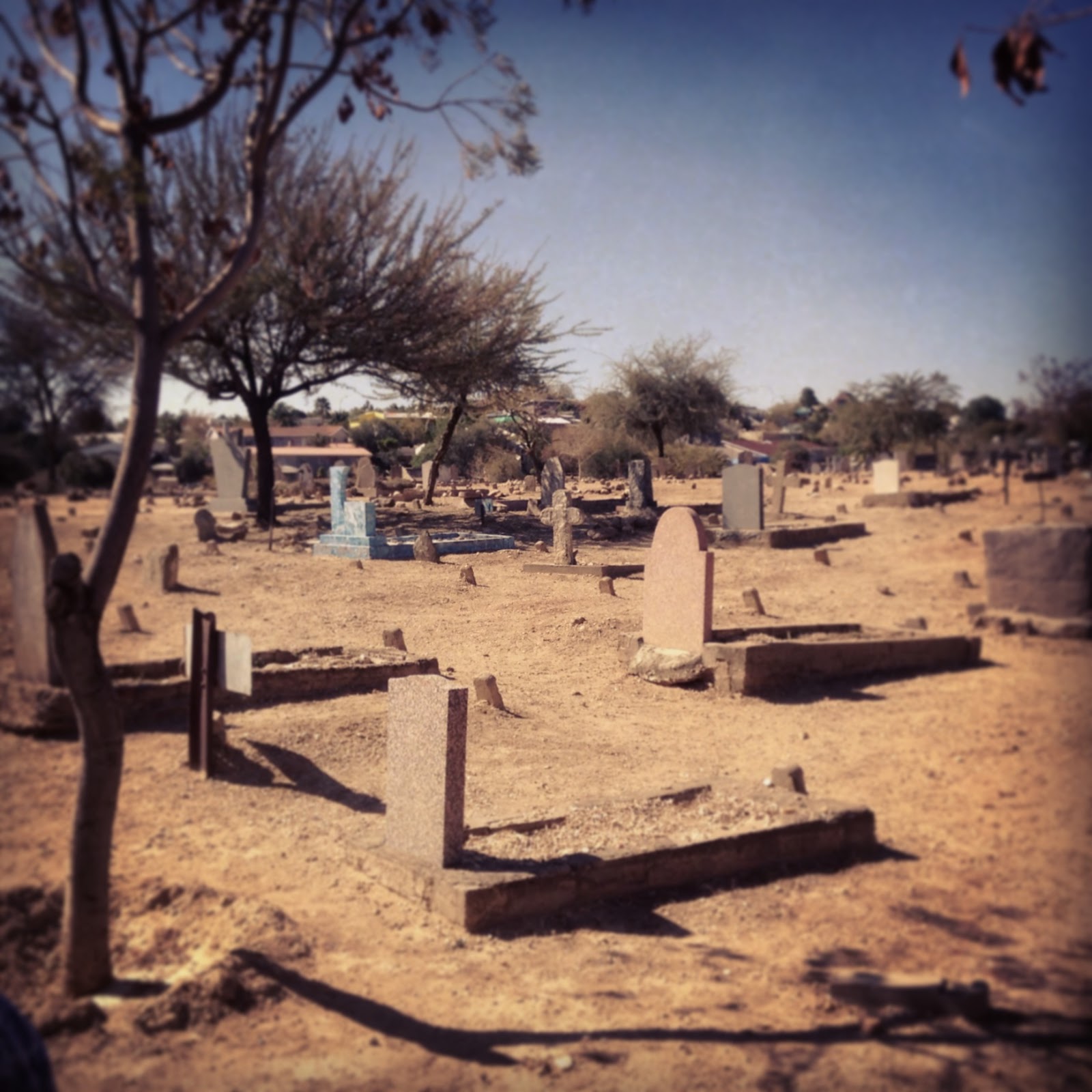
Our next stop was at the 1959 Heroes' and Heroines' Cemetery in the Old Location in Windhoek. In the days of Apartheid, black Africans were forced to live in settlements called "locations." Officially segregated communities are a thing of the past in Namibia, but people still refer to the past boundaries as "the location" or "the old location."


The 1959 Heroes' and Heroines' Cemetery opened after independence to commemorate the site of a massacre. The Apartheid government designated a neighborhood near Windhoek as a location, then called the Main Location. Many black people who worked in Windhoek lived there. One day, the government decided to reclaim the land for white settlement. When the black population refused to move to Katutura (which means, "The place where people do not want to live" in the Herero language) an area far, far away from the Location, the government murdered an untold number of the roughly 7,000+ residents. This event took place on December 10, 1959, a day which is now marked as Human Rights Day.  


The Cemetery is considered hallowed ground, and one of the highest honors that can be bestowed on a Namibian is to be buried there. 

Sunday, August 11, 2013

First Impressions of Namibia


Our plane landed in Windhoek in mid-afternoon, after a 15-hour flight. Most of the places I have been in South America and Europe, the first sight of the country from the plane is nothing special...Everywhere pretty much looks like everywhere else from a landing airplane. But not Namibia. The view from the window showed a dry landscape, with undulating, sandy hills spotted with browning trees and shrubs (July is winter/dry season in Namibia) and green oases of vegetation.

Deboarding the plane, I looked at my new home for the next two years. Rocky mountains surrounded the airport and the sky was clean-lake blue with not even a hint of a cloud in the sky. The temperature was cool enough to wear a jacket, but the sun was strong enough to make me sweat under the burden of my carry-on bags.


The airport is strikingly small for a capital city. There were two lines, one for Namibians and members of countries with which Namibia has special border agreements, and the other for foreigners. Processing took quite a while and was done by three friendly agents. Peace Corps' country director and administrator met us after customs to welcome us and collect our International Vaccination Cards.


We boarded a bus that would take us to Okahandja, a smaller town outside of Windhoek where Peace Corps conducts its pre-service training. We would be staying with host families, but only after a week at the training center. Our trainers and the hotel staff greeted us with singing and insisted on helping us with our luggage as we went to our rooms.

The first thing I plugged into the wall with an adapter (my electric shaver) blew a fuse due to my inexperience with using electricity in Namibia. There are kill switches by every outlet, which must be switched off when you plug in your electronics. Procedure is: make sure the kill switch is on, plug in your adapter, plug in your electronic device, then flip the switch on to make the outlet live. 


Staging

Peace Corps flew me into Philadelphia on a USAirways flight. I met Mark at the airport and we split a taxi to the hotel and were surprised to find that we were roommates (not planned). We got a bite to eat and went swimming and called our loved ones, then called it an early night.

Staging was a straight-forward, uncomplicated process. We registered. I was nervous because my student loan servicers told me I would not be able to arrange a deferment until November, when I would be in Namibia. It wasn't a problem, though - apparently, pretty normal. We did some getting-to-know-you activities, then went through cross-cultural scenarios, reflected on our reasons for doing Peace Corps, then got a debit card with pre-loaded cash to withdraw for incidental expenses like food and "walk-around" money while in Philadelphia. Session lasted from 10am until around 4:30pm.

I went out for my last meal and had salmon with lentils. I figured salmon would be a food I wouldn't find easily during my stay in Namibia. We came back to the hotel and I began the laborous process of getting my checked luggage bag down to 50 pounds. The downside to not being charged excess baggage fees would be having to carry around lots of extra weight in my carry-on.


We convened in the lobby of the hotel at 2am, and boarded the bus that would take us to JFK in New York City, where our flight to Johannesburg would be leaving. We arrived at the airport around 4am, and ate donuts and drank water until the plane left at 11am. Leaving the United States was a surreal moment, and an unexpectedly emotional one. I cried a little bit during take-off. I thought of the family members and friends I wouldn't see for another two years, my ailing grandmother - sad things - but also cried tears of joy over my excitement about having a job that engaged all of my talents, two years in an entirely new and different culture, and because my heart was filled with love for the people I had yet to meet and the mission I was now a part of.